
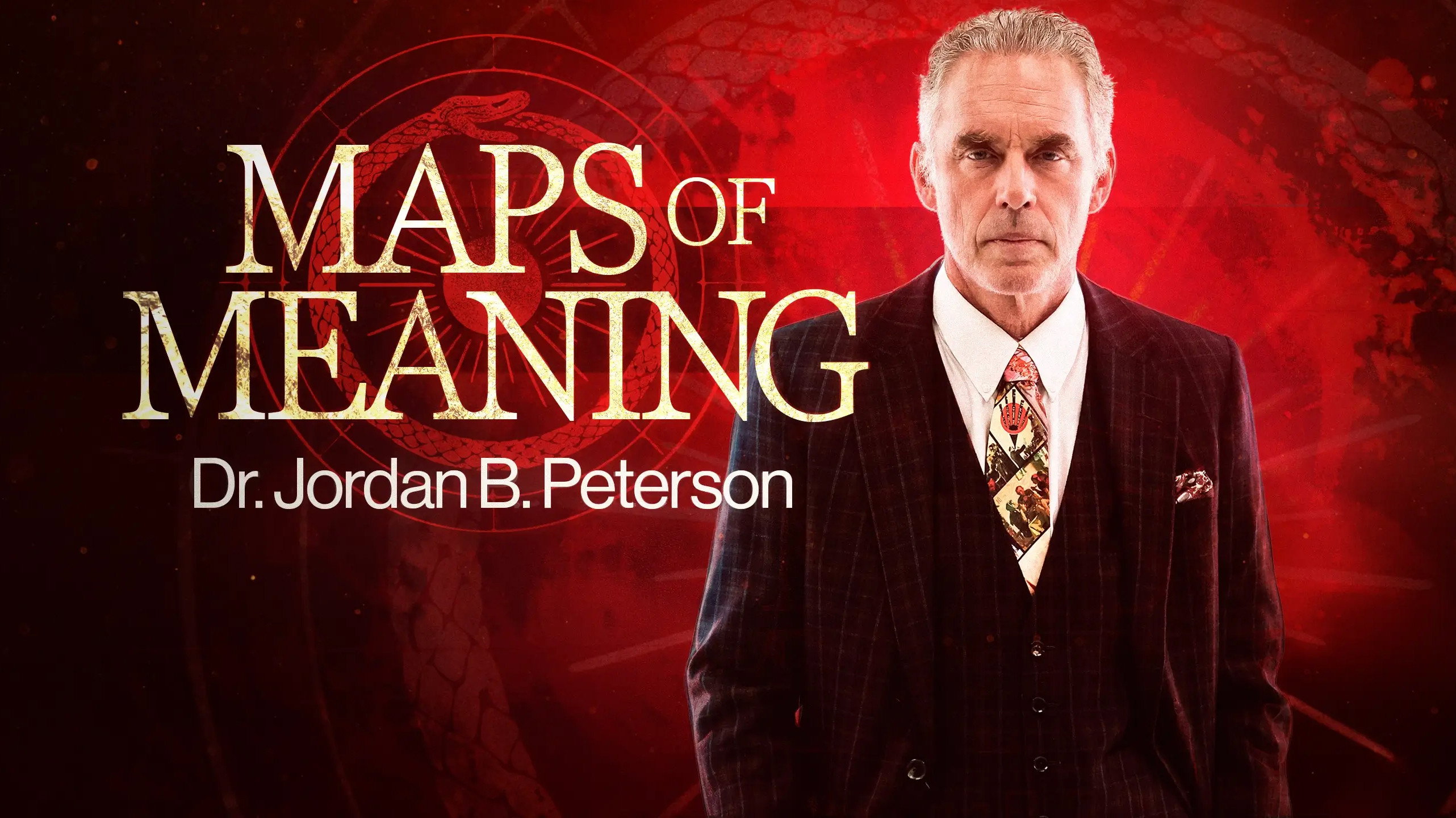
Maps of Meaning
In Maps of Meaning, a twelve-hour course, Dr. Jordan B. Peterson explores the foundations of human consciousness, perception, and the pursuit of meaning. Drawing from psychology, mythology, and neuroscience, he examines how we navigate the tension between order and chaos—not as passive observers, but as active participants guided by goals and values. Central to this exploration is the archetypal hero’s journey, which shows how voluntarily confronting suffering and taking responsibility can transform both the individual and society. Grounded in decades of research and personal experience, Dr. Peterson reveals how religious symbols, archetypal narratives, and social hierarchies shape both the individual mind and collective culture. Through powerful insights, the course demonstrates that proper orientation toward the highest good enables us to transform chaos into meaningful order.
First Aired
2025-11-13
Status
Ended
Seasons
Season 1 Episodes
Watch All →E1. What Is, What Should Be
In our introductory lecture, we explore two fundamental ways of perceiving the world: the materialist view of what the world is made of versus the action-oriented view of how to act in the world, arguing that the latter is primary since perception itself requires action and is always directed toward goals. Dr. Peterson explains how our experience is structured as a cybernetic frame moving from "what is" to "what should be," which forms the basis of all stories and is validated by our emotional systems that signal progress toward or deviation from our aims. The lecture concludes by emphasizing that finding the proper aim—one that sustains us individually and socially while promoting growth—is essential, as this alignment produces the deep sense of meaning that guides human development and flourishing.
E2. Pathways and Obstacles
In lecture two, we study how to find one's way forward through self-negotiation, examining how we perceive the world not as objects but as pathways, tools, obstacles, friends, foes, and agents of transformation. We look at the hierarchical nature of games we play in life, from simple rule-following to meta-games that facilitate personal and collective development, illustrating how obstacles and unexpected events serve both as dragons to be confronted and treasures of potential transformation. Dr. Peterson concludes by outlining how we respond to radical novelty and chaos, emphasizing that the optimal attitude for confronting the unknown involves courage, faith, and the pursuit of truth aimed at love, enabling us to transform chaotic possibility into meaningful order.
E3. Sacred Balance
In lecture three, we analyze the ancient concepts of yin and yang as fundamental representations of chaos and order, examining how these principles manifest in consciousness, mythology, and human relationships. We delve into fairy tales and profound biblical stories to illustrate how the feminine principle represents chaos, possibility, and the unknown, while the masculine represents order and structure, and how both can become pathological when taken to extremes. The lecture concludes by discussing the importance of balancing chaos and order in life, the role of conscience and calling as divine guides, and how hospitality and proper orientation toward these fundamental forces can lead to meaning and psychological health.
E4. Conceptualizing Reality
In lecture four, we continue to investigate how reality is conceptualized through phenomenological, cybernetic, and narrative perspectives, framing experience as a balance between order—predictable and goal-oriented—and chaos—the unexpected and anomalous. We examine how this duality is symbolically represented in narratives and religious texts, how the brain’s bicameral structure reflects it, and how attention functions as the transformative force that turns chaos into order. Finally, Dr. Peterson elucidates how we simplify complex reality into icons and language for practical use, emphasizing that mastery of both domains through focused attention and truthful engagement enables meaningful transformation and a deeper understanding of existence.
E5. Hierarchies of Being
In lecture five, Dr. Peterson introduces us to the concept of nested dependencies and hierarchical structures in reality, using examples from life to illustrate how disruptions at any level—from quantum to cosmic—can cascade through interconnected systems. We examine Jacob's ladder as a metaphor for the hierarchical nature of being and moral development, demonstrating how complex actions decompose into simpler components and how proper orientation toward the highest good transforms both individual psychology and physiology. Dr. Peterson emphasizes that our choices and orientations not only shape our immediate circumstances, but potentially influence our genetic expression and even that of future generations.
E6. Agents of Transformation
In lecture six, we learn how human consciousness and society are organized through the integration of religious symbolism, social hierarchies, and neuropsychological structures. We examine how individuals and cultures structure value—from ancient Mesopotamian deities to modern psychological frameworks—and how humans often enact patterns of wisdom before fully understanding them. The discussion delves into our core memory systems and how brain hemispheric specialization enables us to navigate between order and chaos. Dr. Peterson posits a uniqueness fundamental to humans—that rather than mastering only fixed domains, our neurological architecture equips us to engage with transformation itself. He concludes by highlighting how our brains' emphasis on hands, eyes, and speech reflects our unique capacity as active explorers and world-shapers, capable of revising the very principles by which we live.
Cast
Jordan B. Peterson
Host
More Like This

WWE 24
History 101

How Do They Do It?
Buzzfeed Unsolved: Supernatural
Eli Roth's History of Horror

Beyond Stranger Things

Hulk Hogan: Real American

30 for 30
Mind Field

McCartney 3, 2, 1

Visible: Out on Television

Top Gear

Watch the Sound with Mark Ronson

The World According to Jeff Goldblum

Horizon

Down to Earth with Zac Efron
Mysteries at the Museum

JANET JACKSON.
NOVA

The Reluctant Traveller with Eugene Levy